


Issue 420
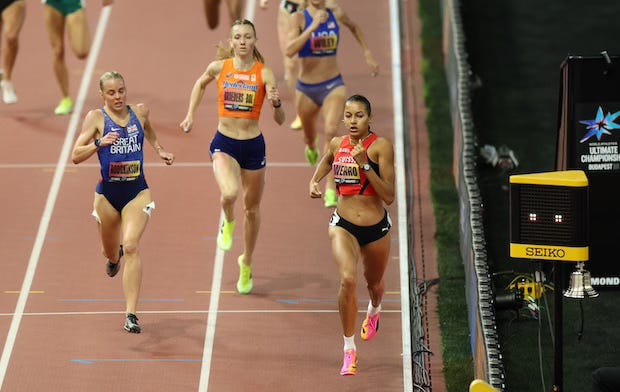
Audrey Werro surpassed all expectations with her unbeaten season
When World Athletics announced the inaugural World Athletics Ultimate Championship two years ago, the press release used words like “groundbreaking” and “revolutionary,” and indicated that the event would “transform the athletics calendar.” I’m not sure any of that happened over the weekend, but the first ultimate championship, held in Budapest, seemed like a nice step forward.
The races themselves were not all that different from the Diamond League final one week earlier. In two of the three women’s middle-distance and distance events, the winners were the same as the week before. It was nice for some of the athletes to get significant paydays on back-to-back weekends, but the fact that the fields were largely the same removed some of the suspense at the ultimate champs.
Switzerland’s Audrey Werro completed one of the best-ever seasons by a women’s 800m runner and remained unbeaten, running 1:55.88 to Keely Hodgkinson’s 1:56.26 and Femke Broeders-Bol’s 1:56.74. Their finish order was the same as the last time they raced, at the European Athletics Championships one month earlier. After earning $60,000 at the Diamond League final, Werro picked up another $150,000 in Budapest—a nice reward to end a season that surpassed all of her expectations. There’s no way she’s not in the conversation for World Athletics’ World Athlete of the Year.
When she missed several key races, it was clear something was up with Great Britain’s Hodgkinson, and she revealed after Saturday’s race that she suffered a hamstring tear at the European Championships. Considering her limited buildup, she was pleased with what she was able to accomplish. Of the top three in the 800m, only Hodgkinson will continue her season and race at Friday’s Athlos meet in London.
Addy Wiley was the best of the rest, finishing fourth in a season’s best of 1:57.54 and rebounding nicely after a rough race at the Diamond League final. Two more Americans also competed in Budapest. It was good to see Raevyn Rogers in the field, and she just missed out on the final by 0.08 seconds, running 1:59.86. She’ll race again at Athlos on Friday. And Roisin Willis had planned to race Athlos, but after finishing seventh in her semifinal in 2:00.11, she announced that her season is over. (800m replay and results)
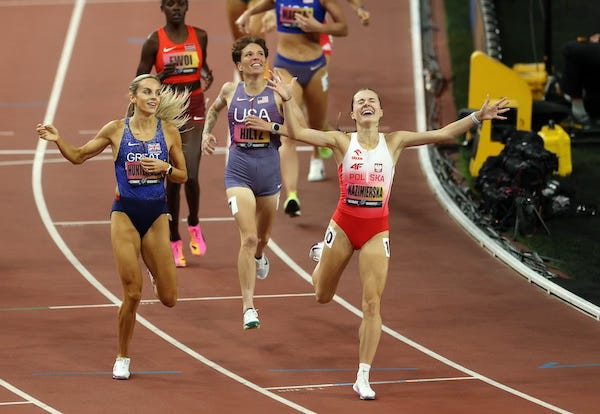
Klaudia Kazimierska times her peak just right
While Poland’s Klaudia Kazimierska was somewhat of an unexpected winner in the 1500m at the Diamond League final, it was no surprise to see her repeat as champion one week later, in 3:57.55. She timed her peak just right, had her best races when it counted, and came away $210,000 richer between the two meets (minus taxes and agent fees, of course).
While Kazimierska was an excellent collegiate runner for the University of Oregon, she never won an NCAA title, and I wouldn’t have guessed she’d be the world’s best 1500m runner 15 months later. But it will be interesting to see how she can build on this going forward.
After having a bit of an off day at the Diamond League final, where she finished fourth, Great Britain’s Georgia Hunter Bell rebounded nicely, challenged for the win up the homestretch, and finished second in 3:57.72, 0.17 seconds back.
Her secret for summoning her best effort after feeling physically and mentally tired one week earlier? “I listened to a lot of Vivaldi’s Spring, a very hopeful song. I did Reiki to try and get rid of any bad energy,” she told the BBC. “I went to the spa with Keely—she made me sit in the sauna for like 20 minutes and sweat out all the bad energy. And I worked with my coaches to get my belief and hunger back. It was definitely there today on the home straight.”
Hunter Bell actually closed a little faster than Kazimierska, running 57.36 seconds for her last lap, compared to Kazimierska’s 57.44, but Kazimierska was in a better position at the bell. At the Diamond League final, she won from the back of the pack, but here, she won from close to the front.
And Nikki Hiltz put together an excellent run, finishing third in 3:58.16 and holding off Ethiopia’s Freweyni Hailu (3:58.44), Kenya’s Dorcus Ewoi (3:58.55), and Australia’s Abbey Caldwell (3:58.64). The other U.S. runner in the field, Emily Mackay, finished seventh in 3:59.16. (1500m replay and results)
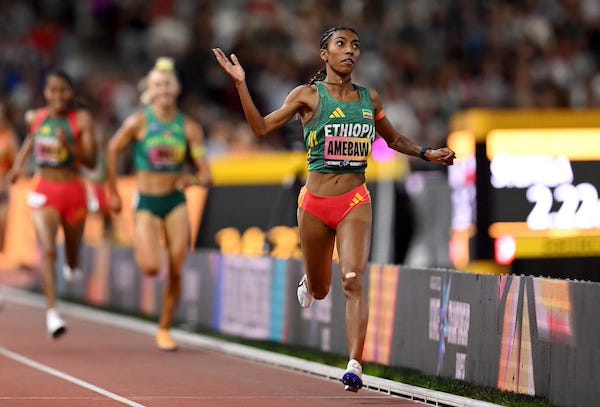
Likina Amebaw’s gutsy race pays off
I appreciated that the 5,000m was the one women’s middle-distance/distance event that had a different winner than the week before. Hailu, the Diamond League 5,000m champ, doubled at the ultimate championship and it’s hard to say if that hurt her chances of winning on back-to-back weekends. She took fourth in both the 1500m and 5,000m.
It was nice to see Diamond League runner-up Likina Amebaw of Ethiopia take a chance mid-race and be rewarded for it. Around halfway, she struck out on her own and gradually built an eight-second lead. Though the chase pack closed the gap in the kick, Amebaw held on and won in 14:30.36.
The battle for second was exciting, and I appreciated that the broadcast actually showed it. Australia’s Jessica Hull ran a 13.97-second final 100m to take second in a PR of 14:32.39, holding off Ethiopians Fantaye Belayneh (14:32.62), Hailu (14:32.76), and Aleshign Baweke (14:32.95). Hull had a rough outing in the 1500m, where she finished ninth, so it was good to see her bounce back so well.
Because there was no limit on the number of entrants any country could send to this event, six of the 12 runners in the field were Ethiopian. The U.S.’s lone representative, Shelby Houlihan, finished 12th in 15:18.65. (5,000m highlights and results)
What the meet did well
Holding much of the event at night and being creative with the lighting made for some good visuals. It looked like a track meet, but 50 percent cooler than usual. I liked that they had a non-traditional podium, too.
I liked the tighter schedule—there was usually something happening at all times and it was clear what it was. And I liked that the schedule seemed more coordinated, so that distance races were less likely to be interrupted by field events, and vice versa. I’m curious how that felt to the athletes—was it rough standing around waiting to be told they could throw or jump?
They paid well. Assuming they pay the athletes and do so in a timely manner, this event offers the best payday in track and field. Yes, it could be higher and pro athletes in other sports make more, but the prize money was significant and a step in the right direction.
I felt like the Breaking4, Athlos, and Grand Slam broadcasts focused too much on how they were revolutionizing the sport, how great the crowd was (when it wasn’t necessarily), how women’s sports are having a moment, and how much they were paying the athletes. I appreciated that the ultimate champs broadcast focused more on the competition.
I thought the app was pretty useful, and I particularly appreciated it as a place to get results on the go.
I appreciate that World Athletics plans to use the ultimate champs as a testing ground for new ideas. And we might see the changes that are popular implemented at the world championships and Olympics as well.
Where I think there’s room for improvement
The win probability stats on the broadcast were laughably terrible. It almost felt like an intern (or AI) was in charge and no one thought to review them in advance. Or maybe they were just meant to serve as rage bait to get people talking.
I sympathize with all of the athletes whose events were excluded from the meet. Discus thrower Matt Denny and hammer thrower Camryn Rogers weighed in on that last week. I think it’s World Athletics’ responsibility to provide opportunities for all of the events in track & field, and I don’t think it’s fair to do so selectively.
The schedule could have been even tighter in some cases. I could have done without the 800m semifinals, especially since they mostly felt like a formality for the top women.
Selecting athletes based solely on their world ranking doesn’t in all cases attract the athletes who are competing the best or have the most momentum right now.
This might just be a me problem, but finding three hours to watch this meet three days in a row was essentially impossible for me, so I ended up watching selectively on days two and three. Maybe if the stakes were higher, or if this was a world championship or Olympic Games, I would have found a way. But I understand why the sport is struggling to get people’s undivided attention. Nine hours of coverage, in the middle of the day in the U.S., is a lot.
In a sport where at least the top three athletes tend to earn medals, World Athletics made the decision to only award a trophy to the ultimate champion and no one else. I get it, but I think giving medals to the top three would give fans—and the athletes—a little more to get excited about.
Maybe it wouldn’t work here, but I’d like to see pro track meets have more of a team component, beyond relays and medal counts. When I think about the track meets I’ve gotten the most invested in over the years, they are the ones with team scoring. I think that’s the best way to make everyone care more about the smorgasbord of events that make up track and field.
Criticism aside, I am glad World Athletics is trying something new, and I think that because of their experience, access, existing fan base, and knowledge of the sport, they have a better chance of succeeding than Grand Slam Track did or Athlos does. The product may require some tweaking, but I’m glad it exists and that the athletes are benefitting from it.
If the goal is to bring in new fans, I am curious how successful they were. My non-running-fan friends certainly weren’t talking about the event. It’s so hard to get people’s attention in general these days. Short of world records or young people running really fast, it seems like something going wrong—a mid-race fight, an animal interfering with competition, or someone nearly getting hit by a throwing implement—is more likely to gain momentum on social media, sadly.
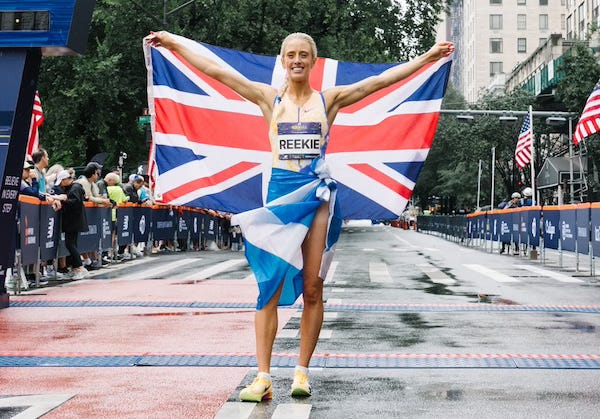
Jemma Reekie wins her third title on Fifth Avenue
It’s been an up and down season for Scotland’s Jemma Reekie, but she ended it on a high note on Sunday with a win and event record at the Fifth Avenue Mile in New York City.
While racing an 800m in Poland in May, Reekie, 28, took a really hard fall and suffered a concussion that affected much of her season. But things have come together for her late in the season. A week ago, she set a European road mile record of 4:23.25, and on Sunday, in the rain, she earned her third win on Fifth Avenue in an event record of 4:13.8. (The Fifth Avenue course is not world record or area record-eligible.)
With some significant competing events—the World Ultimate Championships, and this weekend’s World Road Running Championships and Athlos—some of the usual stars had to sit this one out, but that didn’t stop Reekie from running faster than anyone ever has on Fifth Avenue, shaving exactly one second off of the record that was jointly held by Laura Muir (2022) and Karissa Schweizer (2024).
This race has gotten so quick that for many of the athletes, it practically looks like an all-out sprint the entire way. It was great to see Josette Andrews, after she missed the entire track season, line up and take second in 4:16.2. And Rachel McArthur capped off an excellent season with a 4:17.8 for third.
Reekie also won on Fifth Avenue in 2021 and 2023, but she has skipped the race for the past two years. (Results)
Rachael Rudel wins her first national title and makes her first U.S. team
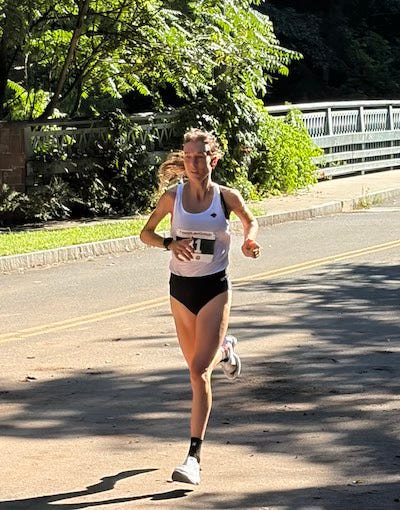
Rachael Rudel, 32, has had an incredible breakout season on the roads, so it was no surprise to see her storm to her first national title at the USATF 20K Championships on Labor Day in New Haven. Rudel hadn’t raced since June, when she finished three seconds behind Kenya’s Sharon Lokedi at the Boston 10K, in a huge personal best of 31:31. But she picked up right where she left off, running 1:04:58 (5:13/mile), the third-fastest time ever on the course, behind only Keira D’Amato (1:04:29) and Emily Sisson (1:04:35), who had a great battle in 2022.
Midway through, it looked like Rudel’s roommate in New Haven, Biruktayit Degefa, might run away with the race. She had built a sizable lead, but over the second half of the race, Rudel and the rest of the chase pack began to close in on her. Rudel caught Degefa around 15K and blew away the entire field over the final 5K, winning by 55 seconds.
We didn’t get to see how the race played out behind Rudel, but Elena Hayday, who is also having a breakout year, recently signed with Puma, and is prepping for the Chicago Marathon, closed well to take second in 1:05:53. Amanda Vestri, who missed out on some summer racing due to an injury, took third in her first race back, running 1:06:05. Kassie Parker, who is currently second in the USATF Running Circuit standings, was fourth (1:06:18), and Lauren Hagans, 40, had a strong run in her NYC Marathon buildup, running a masters course record of 1:06:41 and rounding out the top five. Degefa dropped back to seventh over the last 5K and finished in 1:07:15.
In addition to winning her first national title, Rudel also qualified for her first U.S. team. Because the 2027 World Athletics Road Running Championships will take place March 28 in Yangzhou, China, only about six months after the 2026 edition, it would be difficult for the U.S. to hold selection races like they did this year. So the top finisher at the 20K champs has first dibs on a spot on the team, as will the top U.S. finisher at this weekend’s World Road Running Championships in Copenhagen, provided that they finish in the top 15. The last two spots will be selected based on world rankings. (Details on the selection criteria here.)
Rudel earned $9,000 for the win, a nice boost as she is still unsponsored, but I would be surprised to see her remain so for long. Rudel went straight from New Haven into a work trip and noted on Strava that she took three days off post race “to let the body recover properly…when I travel for work post-race and ‘stressors’ are still high!” (I note this partially because it has seemed in the past like certain runners were practically allergic to taking days off, and now there seems to be a lot more variation in how the top runners train.)
Lori Riley’s Hartford Courant article mentioned that Sara Hall and Fiona O’Keeffe dropped out of the elite field due to injuries. If true, that’s the first I’d heard of either one, and hopefully neither is anything serious. (New Haven Road Race results)
Other News and Links
At the EMU-GOMU 6-Day World Championships in Hungary, Megan Eckert, who is a sixth-grade math teacher, covered an incredible 636.482 miles and set a world record and an outright American record, surpassing the men’s mark as well. She stopped to sleep, eat, and take care of other needs, but she still averaged 13:34/mile for six days straight. (More from iRunFar)
I loved learning more about age-group star Nora Cary in this Runner’s World profile from Pavlína Černá. Cary, 71, began running in her late 20s, and in the 40+ years since, she has slowed down a lot less than almost all of her peers. She has been on a real tear since entering the 70-74 age group last year.
Canadian skyrunner Kalie McCrystal is still missing on the Matterhorn, and it sounds like the search efforts have been paused. This Outside article includes more details about the kind of person she is, and I wish I was learning it all under different circumstances.
I appreciated Juliette Whittaker sharing this very personal speech she gave about her mental health struggles, in honor of national suicide awareness month.
On announced last week that Kenya’s Doris Lemngole has joined the company’s professional roster. I mistakenly assumed that this post from June meant that she had been running professionally for On all summer. In the NIL era, it’s harder to tell when a lot of athletes’ pro careers begin.
It’s worth noting that both of these women are massive outliers. Ali Andrews, who hopes to qualify for the 2028 U.S. Olympic Marathon Trials, has been getting attention for running 2:58:43 at the Sydney Marathon eight months into her pregnancy. And Makenna Myler, who went viral for running a fast mile while she was pregnant with her first child, is putting on an event on October 7 where she hopes to run a sub-5:00 mile nine months into her pregnancy.
Dakotah Popehn said in the latest edition of the Minnesota Distance Elite newsletter that she’s been working hard on two really big projects that she’ll be announcing later this month. “One of them has taken up the better half of the last year and is something I am so excited to share with the world,” she wrote.
Additional Results
Kenya’s Brigid Kosgei won the Great North Run half marathon in 1:06:15. Natosha Rogers, the lone American in the elite field, finished sixth in 1:11:44. (Results)
Italy’s Nadia Battocletti finished out her season at home with a 1500m win at the Palio Città della Quercia in Rovereto, running 3:59.49. Margot Appleton finished third in 4:02.17, taking more than two seconds off of her PR. Slovakia’s Gabriela Gajanová won the 800m in 1:58.37, Rachel Klopfenstein of Mauritius took second (1:58.83), and Nia Akins finished a close third in a season’s best of 1:58.88. (Results)
Juliette Whittaker ran 2:36.03 to win the 1,000m at the Dinamo Zrinjevac International Athletics Meeting in Croatia. (Results)
Less than a month after winning the marathon at the European Championships, Finland’s Alisa Vainio won the Finnish Marathon Championships in 2:27:47. (Results) She’s also planning to race the Berlin Marathon in two weeks and the Valencia Marathon on December 6.
The New Haven 20K also has a half marathon option, which Jamaica’s Michka-Mae Hyde won in 1:13:10. (Results)
Mary van Laarhoven won the Victory 10K on Labor Day in Minneapolis, running 33:50. (Results)
Cailie Hughes won the City of Lakes Half Marathon yesterday in Minneapolis, running 1:11:51, and van Laarhoven took second in 1:12:26. (Results)
Podcast Highlights
Ironman champion and former pro runner Chelsea Sodaro was great discussing the challenges of motherhood as a pro athlete on Trail Society.
I appreciated hearing Jenny Simpson open up about her experience in recent months on The Rich Roll Podcast. I felt that the host could have been a better listener and went in with too much of his own agenda, but Simpson was good so it was still worth the listen.
I appreciated Pete Julian weighing in with his thoughts on the differences between coaching men and women, and why, with a few exceptions, women’s 10K times have been somewhat stagnant on episode 17 of On the Record: The Elite Running Podcast. I think about this quite a bit, because U.S. men’s distance running is in a golden era right now, and the U.S. women just aren’t quite there at the moment. I think the reasons are complex, but it was good to hear him put forth a theory, because I haven’t heard a lot of people attempt to explain it.
Wieke De Boer discussed surviving the recent flash flood in the Grand Canyon on Women of Distance.
I enjoyed hearing from Verna NezBegay Volker, Alison Mariella Désir, and Stefanie Flippin at the start of season three of the Earthmovers podcast. I appreciate them continuing to move the conversation about diversity within trail running forward.
Additional Episodes: Olympic Marathon Trials qualifier Brooke Wildermuth on Road to the Trials | Leah Yingling on I’ll Have Another
It’s been an extremely busy weekend here, so I am wrapping this up later on Sunday night and in much more of a rush than I’d like. But I wanted to thank everyone who sent along support for this newsletter after I included more information on how to do so last week. I am still struggling with my Venmo app. I used to be able to send people thank you messages there, but I am currently unable to. So if you sent along support via Venmo, I can’t thank you enough.
I hope you all have a happy and healthy week.
Alison
The predictions were farcical, but on the whole the meeting was certainly a success. I was in Budapest and really enjoyed it.
A handful of observations:
• I read that Klaudia Kazimierska's recent excellent results come in part from having been asked by her coach to prioritize racing position prior to the final lap. As those of us who have battled in the middle distance trenches know, if you leave yourself with too much to do, sometimes you have too much to do.
• With six Ethiopian in the field, I could not help but wonder if Likina Amebaw's win was a team effort. I've seen that before, in the World Championships in Tokyo in 1991. Richard Chelimo, who I think was 19 at the time, ran laps 2-5 of the 10,000 meters in around 4:01. He built a huge lead, maybe 100 meters, and everyone let him go (to my mind, that race marked the end of the "I don't want to suffer, so I'm happy to run a sit and kick championship race even if I come 9th" era). Around a mile before the finish, the other Kenyans began to chase Chelimo. But they waited long enough that they were the only ones who could get close. Moses Tanui, I think, caught Chelimo with 600 or so to go, they had a brief chat, and Tanui went on to win. Chelimo hung on (easily) for gold. But the thinking in the stadium was that there had been a plan among the three Kenyans, and that it had worked.
• World Athletics marketing is and has always been dreadful. Years ago (during the corrupt Diack years, which followed the corrupt Nebiolo years) I pitched the IAAF on a marketing strategy that was athlete-focused, but of course they were uninterested. This "Ultimate" championships, while as you say, seemingly well-executed, was poorly marketed, and even during the event, the announcers had obviously been instructed to present it as though it were on a par with the Olympics and World Championships, which it obviously is not (yet).
• Agree on the probability stats, though my first thought is that World Athletics did some sort of paid tie-up with Kalshi or one of the other betting companies, ugh.