



Issue 424, sponsored by Lane 9
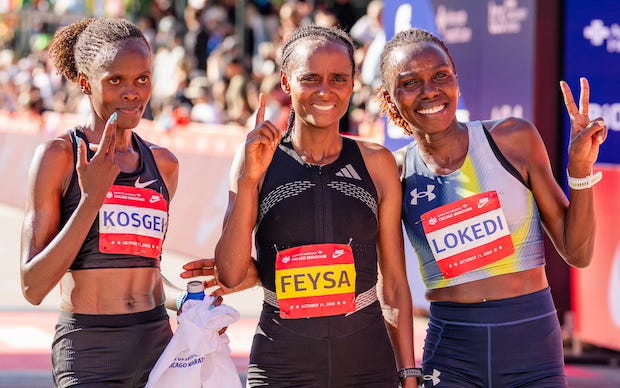
Chicago came down to a great battle between Hawi Feysa and Sharon Lokedi
It would be understandable if defending Chicago Marathon champion Hawi Feysa of Ethiopia felt a little overlooked heading into this year’s Chicago Marathon. She had a breakout performance at last year’s race, lowering her personal best from 2:17:00 to 2:14:56. But at the Tokyo Marathon in March, she finished third, more than three minutes behind Kenya’s Brigid Kosgei, which resulted in Kosgei getting more of the pre-Chicago attention.
In the week leading up to the race, however, Feysa said that she had been dealing with food poisoning in Tokyo, as well as some pain in her knee. The underlying message: Discount her at your own peril.
Initially, it looked like the race might be a battle between Feysa and Kosgei—they had broken away from the rest of the field by 10K. But their 31:04 split (2:11:05 marathon pace and 64 seconds faster than Feysa ran last year) proved to be a little too hot. By 20K, they had backed off slightly, which allowed Kenya’s Sharon Lokedi and Loice Chemnung, who were running a more steady pace, reel them back in. The quartet went through halfway together in a blazing 1:06:06. Impressive considering that Feysa’s PR is 1:05:41 and Lokedi’s is 1:05:00. Chemnung (1:04:01) and Kosgei (1:04:49) have run a bit faster.
But by 30K, Lokedi and Feysa had broken away, and they battled until the final mile. I thought the TV coverage was generally better than usual this year, but the way they handled the women’s finish was frustrating.
I understood when we missed the women because the top men were finishing. I even understood when they went to a commercial break after that. But to come back from the commercial break and show an interview with an Abbott VP that had nothing to do with the outcome of the race sent the message that the women’s race didn’t matter. I’m sure people sitting in the booth were frustrated, too, and I’d like to know the story there, but the whole thing was unfortunate and seemed avoidable. This YouTube link shows a little more of the women’s finish than the broadcast did (but still includes the Abbott interview, which was fine, but very poorly placed).
With just over 1K to go, Feysa took off and Lokedi had no response. Thanks to their fast start and likely the warming conditions, both were struggling in the closing miles, but Feysa managed a 4:59 mile to win comfortably, 2:13:33 to 2:14:07.
Were it not for the world record Kenya’s Ruth Chepngetich ran in Chicago two years ago, Feysa’s time would have been a course record. Five months after Chepngetich’s world record, she was banned for doping. The mark still stands because it came first, but it’s suspicious, and Feysa missed out on the $50,000 course record bonus because of it. But she earned $100,000 for the win.
Lokedi’s final mile, a 5:34, was likely her slowest of the race, but her first hard-from-the-gun marathon on a flat course was a tremendous success, and she PRed by a whopping 3:15. I was impressed by how well she made the transition to this very different style race.
Kenya’s Mary Ngugi-Cooper let many of her competitors go from the beginning, and went through 5K in 10th place, 43 seconds out of the lead. Throughout the race, she moved up and others dropped out. By the end, she had moved all the way to fourth, running 2:17:23, a personal best by 2:03. With a first half of 1:08:52, she was the only runner in the women’s pro field to negative split the race.
After hitting halfway in 1:06:37, Kenya’s Joan Kilimo held on to finish fifth in 2:18:39, with a 1:12:02 second half. Australia’s Izzi Batt-Doyle came close to running even splits, and she was rewarded with a national record of 2:20:38, which placed her sixth. Chemnung, one of the early front runners, faded to 10th in 2:21:18. (Chicago Marathon results)
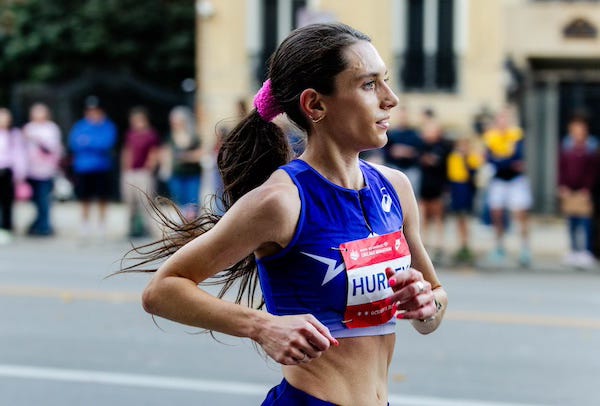
Emma Grace Hurley runs the fastest debut by an American woman
For about an hour and 45 minutes, I wondered if Emma Grace Hurley might be immune to many of the challenges that most first-time marathoners face. She said that she felt great through 20 miles, which was about as long as she had a pacer. Then, as they tend to do, things got tougher.
But even as the temperature rose and she wasn’t feeling great, she hung in there, never getting slower than 5:33 pace. She was rewarded with a seventh-place finish in 2:20:47, the fastest debut by an American woman. She moved to sixth on the U.S. all-time list and her time was the fastest by a U.S. woman in more than two years.
After the race, she questioned whether she picked up the pace a little too much in the 19th mile, speculating that she might have been able to finish a little stronger if she had been patient a little longer, but her post-race comments indicated that she was very happy with how it all went.
After going through halfway in 1:09:50, she ran the second half in 1:10:57. Chicago’s prize money for the open field only goes five deep, but she earned $15,000 for being the top American woman, and hopefully some nice bonuses and an appearance fee as well.
Dakotah Popehn, who finished 12th in 2:24:00, was the next American woman across the line. She has PRed at her last three major marathons, running 2:24:20 in Chicago last year, 2:24:04 in Boston this year, and then shaving another four seconds off here. There’s no doubt she wants to take a bigger chunk off one of these days, but she continues to move in the right direction. And her Minnesota Distance Elite teammate Elena Hayday backed up her breakthrough 2:24:45 performance in Boston with another strong run, finishing 13th—just like she did in Boston—in 2:24:57.
Natosha Rogers told reporters before the race that it’s been a rough year because she’s needed extensive dental work, and she’s dealt with a series of injuries and ailments on the right side of her body. She finished 14th in 2:27:22. And Amanda Mosborg dipped under 2:30 for the first time, finishing 15th in 2:29:30 and taking 2 minutes, 31 seconds off of her personal best.
Whether it was because of the fast early pace, the warmer-than-ideal conditions, or other factors, many in the pro field struggled. Kenya’s Brillan Kipkoech, Ethiopians Sutume Asefa Kebede, Megertu Alemu, and Fantu Worku, Great Britain’s Amy-Eloise Neale, and Susanna Sullivan, Molly Born, Gabi Rooker, and Lexie Thompson were all unable to finish. That’s 31 percent of the pro field.
Neale said in an Instagram story that she did everything she could to recover from a hamstring strain two weeks out, but it wasn’t quite enough.

A huge thanks to Lane 9 for supporting Fast Women this month
Low energy. Low ferritin.
Missing periods.
Injuries that keep coming back.
A complicated relationship with food, or your body.
Lane 9 was started by women athletes, for women athletes. For years, we went without adequate healthcare; these issues were dismissed as “normal” just because we were runners.
We started by sharing athlete stories—getting women to talk about periods, body image, disordered eating, and why it’s hard to be honest about the struggles we may face in sport.
Then we built one place for you to find your providers, the ones who value women’s health and women’s sports. So you don’t have to figure it all out alone. In Lane 9, you’ll find everything from nutrition and mental health support to medical providers, coaches, and physical therapists.
It’s easy to build your sport-specific healthcare team in Lane 9. Go to Lane9Project.org/directory to search for and connect with a clinician near you.
Other Chicago Marathon Notes
Switzerland’s Catherine Debrunner won the wheelchair division by a whopping 8 minutes, 45 seconds, in a world record of 1:33:16. She already held the record, which she set at the 2023 Berlin Marathon, and she shaved off exactly one minute in Chicago. She earned $40,000 for the win plus another $50,000 for taking down the course record, which was previously 1:36:12.
Ethiopia’s Gemedu Dedefo is the marathon coach of the moment. He coaches race winner Hawi Feysa, he coached Tigst Assefa to her recent Berlin Marathon win in 2:11:04, and he coaches 2:10:51 runner Fotyen Tesfay, the second-fastest woman of all time. The three now occupy the second, third, and fourth spots on the world all-time list. Only Ruth Chepngetich, who is serving the aforementioned doping ban, has run faster.
Brigid Kosgei’s 2:14:55 made her the fastest third-place finisher of all time. It was the first time three women had ever broken 2:15 in the same race. Citius Mag reported that she is voluntarily participating in an enhanced anti-doping program with a minimum of 25 no-notice out-of-competition tests per year. She said that leading up to Chicago, she was being tested two to three times per week, and she wants to prove to young athletes that she’s doing what she’s doing without doping.
Sara Hall was the top masters runner, finishing 19th among the women in 2:32:35. (She said she was proud of how she fought, even though she was disappointed with her time.) And Maria Lindberg, who has been racing Hall since she was a teenager, finished second in the masters division in a personal best of 2:34:18. Both are 43.
Eleven U.S. women ran under the 2028 Olympic Marathon Trials qualifying time of 2:37:00 in Chicago, and four of them earned their first Trials qualifier of this cycle: Emma Grace Hurley, Kelby Laughner (2:35:41), Alli Sefanov (2:35:50), and Sarah Chandler (2:36:06).
Canada’s Claire Sumner was the top finisher from the mass start. She finished 18th among the women in 2:32:21.
Perhaps it was the weather, but while the 2025 race produced 61 sub-2:45 and 393 sub-3:00 performances, this year, 49 women broke 2:45 and 316 broke 3:00.
According to the preliminary results, the following athletes won their age groups: Australia’s Emalina Fogale (19 and under, 3:18:01), Mexico’s Argentina Valdepenas Cerna (45-49, 2:39:54), Juliet Hershey Beatty (50-54, 2:56:11), Great Britain’s Joanne Stanfield (55-59, 3:00:05), Portugal’s Odete Braga (60-64, 3:11:38), Japan’s Tomoko Yamada (65-69, 3:15:21), Grace Wasielewski (70-74, 3:51:52), Trudy Fortino (75-79, 4:49:18), and Sara Donovan (80+, 7:01:58).
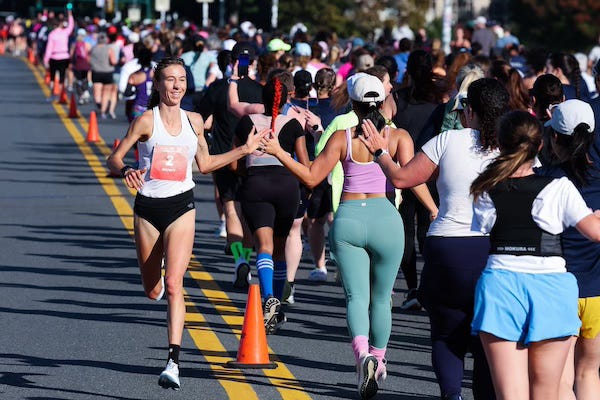
Rachael Rudel continues her hot streak
I was sorry to miss this year’s Boston 10K for Women—one of my favorite races because of its flat course and camaraderie—but Victah Sailer got the perfect photo of race winner Rachael Rudel high-fiving her fellow competitors on one of the course’s out-and-back sections.
Rudel won the race in a 19-second personal best of 31:12 and earned $10,000. It was the second-fastest anyone has ever run on the course, behind only Emily Sisson’s 31:05 from last year. Rudel has been on such a tear, and her decision to skip last week’s USATF 10K Championships to prioritize her health appeared to pay off.
It looks like Rudel ran with Elly Henes for the first mile (a 5:08 split) before picking up the pace and running solo—with a lot of people cheering her on—the rest of the way. I was also super impressed by Maggie Donahue of the B.A.A. High Performance Team, who ran a big personal best of 32:03 and earned $7,000 for her runner-up finish.
A week after PRing at the USATF 10K Championships, Amy Davis-Green, who is 10 months postpartum, took another nine seconds off of her time, running 32:11 to finish third. And Henes, who was running her first race since March thanks to a strained adductor, finished fourth in 32:19, matching her mother’s finish at the 1993 and 1997 editions of this race. (Results)
Other News and Links
Emily Sisson had been planning to race December’s Valencia Marathon, but there’s been a change of plans. She announced last week that she’s pregnant and due at the end of March.
Karissa Schweizer is a YouTuber now. In her first video, she shared what her life looked like nine weeks after surgery, and I think her channel will be a good addition to what’s already out there.
Makenna Myler, who has a tradition of running an all-out mile nine months into her pregnancies, ran an incredible 5:22 with baby number three and turned it into a community event. While pregnant with her first child, she ran a 5:25 and went viral, and during her second pregnancy, she ran a 5:17.
Betsy Saina, who had her second child in September 2025, was announced as part of the field for the Frankfurt Marathon, which will take place on October 25. Based on her Instagram posts, it sounds like her training has gone well.
Thanks to Sarah Lorge Butler for pointing out this nice profile of Central Park Track Club coach and Atalanta NYC executive director Devon Martin, from Columbia College Today.
On her Substack, Australia’s Catriona Bisset wrote about menstrual cycle tracking as it relates to training, and some of the advice members of the M11 Track Club have gotten on the matter. “Generally the only negative symptoms I regularly notice relating to my period is that in the week leading up to bleeding I get mild bloating and extreme existential rage, neither of which particularly influence my running,” Bisset wrote.
Tickets to the premiere of Kick, the documentary on Nikki Hiltz, sold out quickly, but it looks like there will be an opportunity to watch the film online beginning November 12.
Jamaican 800m runner Natoya Goule-Toppin has written a book called The Warrior in Me. Earlier this year, the 1:55 800m runner was diagnosed with pericardial effusion and had to spend six days in the hospital. The 35-year-old has been unsponsored all year, but she plans to continue racing at the pro level.
I missed this last week, but one day after she finished second at the USATF 10K Championships in Minneapolis in a PR of 31:57, Kassie Parker won the Blazing 5K in Des Moines in 15:40.
I learned via the latest Minnesota Distance Elite newsletter that Jessica Gockley-Day, who has a half marathon PR of 1:09:00, has joined the team.
I enjoyed this piece from Mary Albl about New Hampshire high school senior Maddy Lane, who is the daughter of two-time Foot Locker champion Erin Sullivan and former pro Matt Lane. I’ve noticed that the athletes whose parents were high level runners are more likely to make sure that their kids hold back in their training when they are young.
Additional Results
The Nuttycombe Invitational, one of the big mid-season tests for collegiate cross country runners, had an exciting finish. With 300m remaining, there were still about 10 runners in the lead pack. First, New Mexico’s Mercy Kirarei made a big move. (She ended up third.) Then Iowa State’s Betty Kipkore made an even bigger move. (She finished second.) And finally Florida’s Judy Chepkoech made the race-winning move, and narrowly edged Kipkore at the line, 19:19.5 to 19:19.6. Chepkoech’s winning time was just 2.3 seconds off of the course record that Parker Valby set in 2023. The Kenyan strength and depth in the NCAA, which is getting better each year, was on full display, with Kenyan athletes sweeping the top eight spots and putting 16 runners in the top 20. The only U.S. runner in the top 20 was Florida’s Claire Stegall, who finished ninth in 19:24.6. West Virginia, who went in ranked ninth nationally, dominated the team race, winning with 66 points. After winning the Falmouth Road Race in August, New Mexico’s Pamela Kosgei, who was racing for the first time this season, couldn’t quite hang with the lead pack in the end. But she finished 13th in 19:35.3, and there’s still time in the season to bridge the gap to the front. (Results | Full replay)
In her debut at the distance, Anna Gibson won the Kodiak 50K in a course record of 3:59:13 and another debutante, Carmen Graves, finished second in 4:04:12. Graves, who is 35 and a 9:32 steeplechaser, is new to the trails and I always love seeing athletes make a smooth transition. (Results)
Rachel Schilkowsky won the Hartford Marathon for a third time, in a personal best of 2:33:54, and Mira Records finished second in 2:38:52. Anna Oeser won the half marathon in an event record of 1:11:12. (Results)
Germany’s Nina Engelhard won the uphill race and the up-and-down race on back-to-back days at the WMRA World Cup final. Erin Moyer led the U.S. squad in both races, finishing third in the uphill race and fifth in the up-and-down race. I was also impressed by Steph Bruce, who finished 10th in the uphill race at age 42.
Podcast Highlights
Allie Ostrander and Lauren Gregory have a new podcast called Crickets Corner, and in the first two episodes, amidst all of the giggling, they discuss some important topics and make some really good points. I appreciated hearing them discuss the pros and cons of training groups for pro runners, and the system that works for them.
I enjoyed learning about 2:36 marathoner Ainsley Pressl on Road to the Trials; she has a good story about patience paying off. Her first couple of marathons were rough, but she kept chipping away and now her marathon pace is faster than her 5K pace was during her first year of college.
I wasn’t familiar with Jess Mena until I listened to her conversation with Stefanie Flippin on Earthmovers, but I loved what she had to say about living in line with one’s values and speaking up about important issues on social media, even if it ruffles feathers.
Australia’s Jessica Hull had valuable things to say about finding satisfaction in running a good race, whether the performance results in a medal or not, on Hurdle.
Thanks to Still I Run, I knew that Saturday was World Mental Health Day, and I appreciated having the opportunity to spend a little of that morning listening to Brigitte Shulze talk about her daughter Sarah Shulze, who ran for the University of Wisconsin and died by suicide in 2022, on the Be Valiant - Powered by Valiant Sports Society podcast.
Additional Episodes: Sara Vaughn on The HAX Show (recorded before she pulled out of Chicago) | Teagan Schein-Becker on The Endurance Lab Podcast | Rachael Rudel on RunWithAlliLive | Kara and Adam Goucher discussed college athletics on the Gettin’ Stuff Done in Higher Education podcast
Ways to help keep Fast Women going
Keeping this newsletter going depends on support from readers and sponsors. If you enjoy Fast Women and you’d like to help, there are a few ways to support it.
A one-time contribution via Venmo.
Monthly contributions via Patreon.
If you use this link to shop at Running Warehouse, a percentage of your purchase will help support Fast Women. (And newsletter readers can use the code FASTWOMEN to save 20% on clothing and socks, and 10% on clearance shoes, nutrition, and hats. The code helps you, and using the above link helps the newsletter.)
I am incredibly grateful to all of you who have helped support this endeavor over the past (nearly) eight (!!) years.
And I am also grateful to Katrina Gaisford, who did a fantastic job of shooting the Chicago Marathon for Fast Women yesterday. All of the Chicago photos here are hers, and I’ll continue to post more of them on Instagram.
This was a long one, I know, but there’s a lot of good stuff going on in the sport right now. I hope you all have the best week possible.
Alison
I know world record rules are probably hard to change, but couldn't the Chicago marathon or WMM just decide to give course record money to any time under the old record?
We were on the course in Chicago yesterday and it was a pretty amazing day! Catherine Debrunner was ahead of most of the men’s pushrim athletes and she looked completely calm and in control of her race. And as for everyone else, despite the heat and sun almost all of the athletes who passed by us over those seven hours looked happy and in charge of their races! There were some cramps (as usual when you’re passing the 40k mark) but the runners seemed to be taking the conditions in stride.