



Issue 423, sponsored by Still I Run
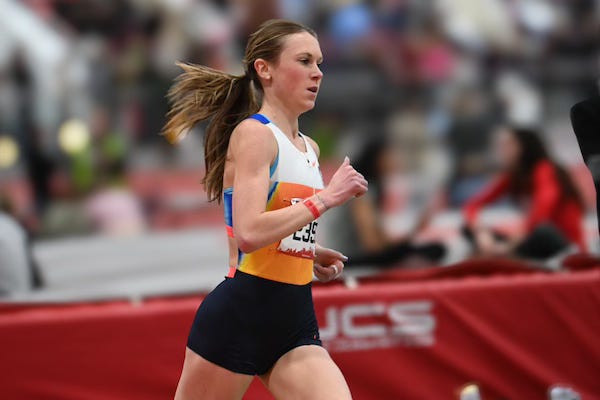
Emily Venters wins her third national title in three months
In July, Emily Venters, 27, won her first two national titles on the roads, taking the USATF 6K and 8K championships in a one-week span. And on Saturday, at the TC 10K in Minneapolis, she added the 10K title as well, leading from the gun and winning by 48 seconds, in a championship record of 31:09.
Venters took most of the drama out of the race by going to the front early and running solo throughout. She covered the first 5K, which was more uphill, in 15:53, and that gave her a 16-second lead over Kassie Parker. Then Venters blazed the second half of the mostly out-and-back course in 15:16. She earned $8,000 for the win.
Parker took second in 31:57, which vaulted her to the top of the USATF Running Circuit standings (which haven’t been updated to include Saturday’s results yet). Allie Ostrander finished third in 32:02, which was just enough to move her into second place in the standings. December’s California International Marathon is the only remaining race in this year’s circuit, and both athletes plan to debut at the distance there. Parker has an eight-point lead over Ostrander, so her odds of winning the circuit are good, but it’s still mathematically possible for Ostrander (and no one else) to overtake her.
Amanda Vestri, who is getting back to racing after an injury derailed her summer racing plans, finished fourth in 32:16. And Amy Davis-Green, who is only 10 months postpartum with her first child, finished fifth in a PR of 32:20. When I wrote about her return to running in April, she had been dealing with some setbacks, so it’s great to see things going so well for her now.
Venters said after the race that she plans to race the Valencia Half Marathon on October 25. She’s one of several David Roche-coached athletes who has been placing more of an emphasis on road racing as of late. And they had a strong contingent in Minnesota, going 1-3-4.
Rachael Rudel, who won the USATF 20K title last month and is also coached by Roche, was a late scratch from the 10K field, and I appreciated her candor about her decision-making process and the fact that she’s prioritizing her health. In short, she said her gut and fueling weren’t where they needed to be in order for her to race, but you can read her full explanation here.
Rudel wrote in an Instagram story after the race, “Emily Venters is out of this world. I want to emphasize that what she did is insane. Me on an amazing day still couldn’t touch this queen!!!!” I think Venters vs. a healthy Rudel would have been an excellent showdown, and I hope it’s one that we get to see before too long. (Results—as I write this, you need to subtract five minutes from the women’s times, because they started after the men and their times have not been adjusted.)
Lilian Chebii breaks the long-standing Twin Cities Marathon course record
The following day at the Twin Cities Marathon, Kenya’s Lilian Chebii ran a race similar to Venters’, going to the front early and staying there. Chebii hit halfway in 1:12:28, with a two-and-a-half-minute lead, and she held on nicely in the second half, winning by more than six minutes, in 2:25:26. She took 85 seconds off the course record that had stood for 25 years.
Jane Bareikis was the top U.S. finisher, taking second in 2:32:04. Like Chebii, she ran in no woman’s land throughout. Caroline Hill finished third in 2:33:26 and took two minutes, 38 seconds off of the personal best she set earlier this year. This was her second time dipping under the U.S. Olympic Marathon Trials qualifying standard of 2:37:00, but the first time she did so was with her maiden name, Garrett.
Ari Fisher finished fourth in 2:34:15, a six-minute personal best, and qualified for the Trials for the first time. Recent University of North Dakota graduate Yonca Kutluk Ala, who represents Turkey, finished fifth, running 2:34:31 in her debut. And running in front of a home crowd, Minnesota Distance Elite’s Dana Feyen took eight minutes, 29 seconds off of her personal best, finished sixth in 2:34:48, and qualified for the Olympic Trials. She and Fisher were the only two new qualifiers, bringing the total to 147.
Gabby Hentemann (seventh, 2:35:41), Piper Atnip (eighth, 2:36:19), and Anne-Marie Blaney (ninth, 2:36:49) had all previously qualified for the Trials, but they dipped under the standard again here.
And men don’t make it into this newsletter for doing good things all that often, but I have to give kudos to Travis Meier who portaged a canoe throughout the race to protest federal efforts to allow mining in the Boundary Waters Canoe Area Wilderness in Minnesota. He somehow managed to cover the course in 5:57:06, which had to be one of the more impressive athletic feats of the day. (Results)

Thanks to Still I Run for supporting Fast Women
Some runs do more than we realize.
Still I Run started with founder Sasha Wolff’s own experience with depression and anxiety. Running became an important part of how she cared for her mental health, and in 2016, she created Still I Run to connect with other people who understood that relationship. Ten years later, Still I Run has grown into a national nonprofit that brings running, mental health, and community together.
This week is National Run for Mental Health Week, October 3–10, a chance to recognize something many runners already know from experience: Running can change how we feel. It can give us space to process a hard day, bring some steadiness when life feels heavy, or remind us that we can keep moving forward. National Run for Mental Health Week is about making that part of running easier to talk about and reminding people that caring for our mental health belongs in the running conversation, too.
The week ends on World Mental Health Day, October 10, with the Still I Run World Mental Health Day 5K. Run or walk the virtual 5K from anywhere and join runners across the country in using their miles to support a more open conversation about mental health.
Who to watch at this weekend’s Chicago Marathon
You know fall is in full swing when the leaves start to change, mornings get cooler, and about 55,000 runners head to Chicago to race 26.2 miles. The Chicago Marathon is one of the events I most enjoy following each year, we’re only six days out, and this year’s race should be particularly good. Here are some of the things that are on my mind as the race approaches:
The weather. If you’re one of the 55,000, I’m sure you have a close eye on this as well. As of now, it looks like things could end up being a bit warmer than is ideal. But there’s still time for that to change, so I will keep my fingers crossed for all of you.
It’s hard for me to pick a favorite going in, but if I had to, it’s probably Kenya’s Brigid Kosgei. She won Chicago in 2018 and 2019, and this is her first time back at the race since then. In March, she won the Tokyo Marathon in 2:14:29, so if she is in that kind of shape and she runs a smart race, she could be tough to beat. Last year’s champion, Ethiopia’s Hawi Feysa, is back as well. She lost to Kosgei when she finished third in Tokyo in March. But if she can replicate or surpass last year’s 2:14:57 in Chicago, few, if any, women will finish in front of her.
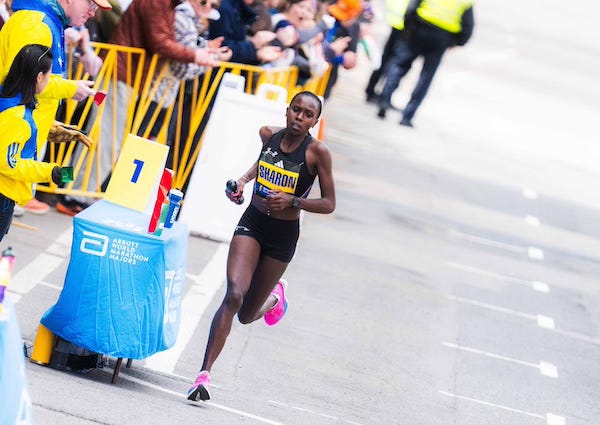
The biggest question mark up front might be what Kenya’s Sharon Lokedi can do on a flat course, where the competitors go hard from the gun. She’s won the last two Boston Marathons and is tough to beat over 26.2, but running this style of marathon will almost be like trying a new event, and I’m excited to see how she fares.
Ethiopia’s Sutume Kebede, who won the Tokyo Marathon in 2024 and 2025, could also be in the mix. Her most recent marathon was a fourth-place finish in Tokyo, though, so in order to win, she’d have to get past two of the three women who beat her there. There are other exciting international runners in the field, but it would likely take a breakthrough day for any of them to challenge for the win.
There is basically no reason for anyone in this race to attempt to go after the $50,000 course record bonus, because the course record is also the world record (2:09:56), and being that aggressive would likely backfire, especially if the weather winds up being on the warmer side.
It’s been a while since most of the top U.S. marathoners have been in action, so it’s going to be really fun to get a glimpse of where things stand on Sunday. The runner with the most buzz around her going in is 28-year-old Emma Grace Hurley, who is making her marathon debut. Her fifth-place, 1:06:23 finish in the half marathon at the World Athletics Road Running Championships showed that her fitness is fantastic, and it’ll be fun to see how that translates to 26.2.
She’ll have a personal pacer in the race, 2:14 marathoner Caleb Kerr, and it sounds like she will likely approach this one a little more conservatively, while also leaving the door open to pick up the pace late in the race.
It will be fun to see if any of the other Americans in the field are feeling ready to go with her, or get off to an even more aggressive start. Susanna Sullivan set her 2:21:56 personal best the last time she raced Chicago, two years ago. Natosha Rogers led the U.S. runners last year, with a PR of 2:23:28. It sounds like she’s had a very challenging year, and I’m not sure what that means for her expectations for this weekend.
Dakotah Popehn ran what was then a PR of 2:24:20 last year in Chicago. She wanted more, and maybe this will be her year. Her Minnesota Distance Elite training partner, Elena Hayday, has been on a roll. She ran 2:24:45, a big personal best, at the Boston Marathon before finishing second at the USATF 20K Championships last month.
Molly Born won her marathon debut at the California International Marathon last December, running 2:24:10, and it will be fun to see what she can do in a different kind of race. She skipped the World Athletics Road Running Championships two weeks ago, and hopefully that was just a strategic decision, to help her run better in Chicago.
Gabi Rooker has a history of racing well in Chicago, and it sounds like things are on the upswing for her, so I look forward to seeing how she fares. And while it’s hard to know where a lot of these athletes stand at the moment, because most marathoners don’t race all that often, Sara Hall just raced a 32:48 10K on Saturday, so we know her fitness is solid, and she seems to be almost always ready to crank out a good marathon.
Sara Vaughn was planning to race, but she said in a post on Friday that she will not be doing so due to a lingering hamstring tear, among other things.
Beyond the pros, I look forward to seeing how many runners we can add to the list of Olympic Marathon Trials qualifiers, and how much depth the race has in general.
The race will stream live on NBC 5 Chicago and you can find more details about how to watch here. The women’s wheelchair race begins at 8:21 a.m. ET, and the pro open fields start at 8:30. If you’re a serious running nerd, you can read the media guide here, and the leaderboard and results will be available here.
Other News and Links
Thanks to Switzerland’s Catherine Debrunner, the women’s pro fields will race on Sunday, the traditional race day, at the 2027 London Marathon. It was previously announced that the race will be a two-day event in 2027 only, but a game of rock, paper, scissors between Debrunner and Kenya’s Sebastian Sawe decided who got to race on Sunday. Debrunner won. It was a fun way to make the decision, and it conveniently helps race organizers avoid criticism over whatever they chose.
Following up on last week’s news that Ethiopia’s Tigist Assefa suffered an Achilles injury during the Berlin Marathon and would undergo surgery last Monday, her coach, Gemedu Dedefo put out a statement saying that she first experienced pain at the 31K point of the race, and then she suffered a severe injury near the 40K mark. He described her injury as a complete rupture of her right Achilles. He said Adidas immediately arranged for a private jet to ensure that she received timely medical care. He told The Athletic (gift link), “She will rest for two months following a rehabilitation program and we hope she can start walking on the third month, and running after three months if everything goes well.”
Gonzaga graduate Rosina Machu has joined the B.A.A. High Performance Team. She finished seventh in the 10,000m at the 2025 NCAA Outdoor T&F Championships and 16th at the 2023 NCAA Cross Country Championships, and she has a 5,000m personal best of 15:21.19.
Australia’s Hayley Kitching, who is now a pro runner for the Brooks Beasts, discussed some of the challenges and rewards of coming to the U.S. for college in this Q&A.
Elise Cranny has touched on all of these themes before, but in this post, she went into more detail about the challenges of trying to get ready for global championships for the past five years, with no off year.
I imagine a good number of running fans wouldn’t be able to name the first woman to break 2:20 in the marathon. Japan’s Naoko Takahashi was the first to accomplish the feat, 25 years ago, at the 2001 Berlin Marathon, where she ran 2:19:46. She’s also the 2000 Olympic champion in the marathon, and this piece from World Athletics, marking the anniversary, includes some of her story.
I appreciated this thoughtful piece from Emma Zimmerman, about trans runner Kae Ravichandran.
Additional Results
At the tRUNsylvania 10K in Brasov, Romania, 20-year-old Ethiopian Asefu Abreha had a breakout race, PRing by more than a minute to win in 30:16. Ethiopians took the top three spots with Aynadis Mebratu finishing second (30:19) and Yenenesh Shimket, 19, running a pending world U20 record of 30:21. The next two runners across the line—Djibouti’s Samia Hassan Nour (30:37) and South Africa’s Tayla Kavanagh (30:50)—both set pending national records. (Results | Livestream)
Kenya’s Joyceline Jepkosgei won the Cardiff Half Marathon in a course record of 1:05:40. (Results | Livestream)
Germany’s Esther Pfeiffer dominated the Köln Half Marathon, running 1:07:23 (results), and Kenya’s Jackline Chepngeno won the marathon by nearly three minutes, in 2:21:33 (results).
Kellyn Taylor, who turned 40 over the summer, won the Milwaukee Lakefront Marathon by 22 minutes and finished eighth overall, in 2:34:14. The first place prize money, $1,500, was relatively modest, but the race offered a $5,000 bonus for breaking the course record of 2:37:39. She also earned $250 for being the first masters runner, bringing her total pay to $6,750. (Results)
Anna Dalton won the USATF 50K Trail Championships, hosted by Oregon’s Perpetua Coast 50K, in 4:29:20. The event was originally scheduled to take place in August, but it was postponed due to wildfires. (Results)
Utah Valley grad Morgan Nokes, 24, won the St. George Marathon in 2:30:06 and Grace Clements took second in 2:32:38. The race is too downhill for times to count as Olympic Marathon Trials qualifiers, but Nokes earned $10,000 for the win, which is a nice consolation. (Results)
Sierra Atkins won the Rock ‘n’ Roll San Jose Half Marathon in 1:14:07 and Nell Rojas took second in 1:15:19. (Results)
Former UVA standout Jenny Schilling won Oregon’s Portland Half Marathon in 1:14:24. (Results)
Andrea Condie won New York’s Wineglass Half Marathon in 1:15:39, and Molly Huddle finished second in 1:16:30. (She wrote in an Instagram story the day before the race, “I wouldn’t say ready… but I’m heeeere!”) Karina Bolton won the marathon in 2:45:08. (Results)
Fresh off her her ninth-place finish in the 5K at the World Athletics Road Running Championships where she represented New Zealand, NC State’s Hannah Gapes defeated a strong field at the Joe Piane Notre Dame Invitational, running a speedy 15:22.6 5K, and Indiana University freshman Katy Zang took second in 15:35.4. Clemson had the strongest team up front, going 3-4-6, but NC State had far superior depth, and they dominated the team race with 39 points. (Results)
Arkansas’ Braelyn Combe was in seventh place, 11 seconds behind the leader, with 1500m to go at the Chile Pepper XC Festival, but she used a big kick to overtake UT Arlington’s Dorcas Jepkosgei right at the line, and won the 5K race 15:59.0 to 15:59.1. (Results | Finish video)
Pittsburgh’s Maureen Cheruiyot won the college gold 6K at the Paul Short Run hosted by Lehigh University, running 19:47.7, but all of the day’s remaining races were canceled due to unseasonably hot and humid conditions. Those who were on site said that so many athletes in the early races required medical attention that it became unsafe to continue the event with a shortage of available medical personnel. (Results)
Podcast Highlights
I loved hearing from Elena Hayday in advance of the Chicago Marathon, on C Tolle Run. Among other things, she discussed the ways in which working with a sports psychologist has helped her.
Every episode of the Ali on the Run Show is a joy, and last week, it was great to hear from both 2:34 marathoner Alana Levy and New York City Marathon finish line announcer Karla Bruning.
At the end of the Relay podcast, Erika Kemp said that it would be irresponsible of her to race this year’s New York City Marathon. She’s healthy, but she’s coming back from a sacral injury, she’s trying to be smart about it, and she has just run out of time.
On I’ll Have Another, Emma Grace Hurley said her current plan is to race Chicago, race another marathon next fall, and then run the Olympic Trials in March of 2028. She’s not planning to move to the marathon full time just yet.
I appreciated NC State runner Kate Putman’s openness as she discussed REDs and period pain on The Lane 9 Podcast.
If you need a nudge to get CPR certified, listen to the latest episode of NYRR’s Set the Pace podcast, featuring Jenny Simpson.
Additional Episodes: Three-time Olympic Marathon Trials qualifier Sarah Reiter on The Fueling Forward Podcast | Anne-Marie Blaney on Road to the Trials | Canada’s Jadyn Keeler on Trackside with Maddie Mooney
This week’s newsletter took much longer to write than I expected, so I’m up past my bedtime and I am almost out of words. I kind of feel like I just portaged a canoe for a quarter mile, because let’s be honest, that’s about as far as I could make it. Thanks again to Still I Run for sponsoring this week’s newsletter, and make sure to check out everything they have going on during National Mental Health Week.
Wishing you all a good week,
Alison
Thank you for sharing Still I Run in this week’s newsletter! As the manager of Team Still I Run (our charity endurance program) I’m totally biased, but this is a great org and the free programming we are able to provide to help people start running for their mental health is amazing.
Three national titles in three months is incredible. Love seeing Emily Venters have this kind of moment, and equally love how you shine a light on the women, stories, and achievements that deserve so much more attention.