


Issue 422
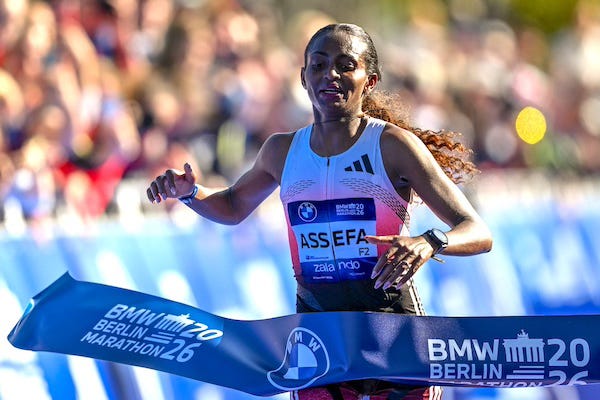
Injury derails Tigst Assefa’s world record attempt late in the Berlin Marathon
For 40K of the Berlin Marathon, it looked like Ethiopia’s Tigst Assefa was going to time trial her way to a well-paced world record. With her team of male pacers, she went through halfway in 1:04:57, on target to take down Ruth Chepngetich’s mark of 2:09:56, from 2024. And many running fans would have been glad to see it go, given that Chepngetich tested positive for a banned substance five months after she set the record and is currently serving a doping ban.
Assefa looked strong, smooth, and in control well into the race. After 25K, she picked up the pace slightly, and ran her next two 5Ks in 15:15 and 15:17. She hit 40K in 2:03:00 and had six minutes, 55 seconds to make it to the finish line, meaning that after averaging just under 4:57 per mile for almost 25 miles, she just had to run the last 2,195 meters (1.36 miles) at 5:04 pace.
But while the broadcast was showing the men’s finish, Assefa suffered an injury to her right Achilles. When the broadcast returned to her just after 40K, she was limping. It was tough to watch her grimace, as she willed herself to the finish line.
She understandably could manage only 5:54 per mile over the last 2.195K, and she broke the tape in a course record and 49-second personal best of 2:11:04, before going straight to the ground. She did not do a post-race interview, and she skipped the medal ceremony.
Later in the day, Pure Vida Sports Africa reported that Assefa is scheduled to undergo emergency surgery in Munich today. Her manager told the outlet that it might be six months before she’s able to compete again.
Even with her injury, Assefa ran the third-fastest marathon ever by a woman and won by nearly six minutes. She earned €30,000 ($34,275) for the win and another €30,000 for breaking 2:15. It was frustrating to watch Assefa get injured chasing a likely dirty mark, though who’s to say the same thing wouldn’t have happened had she been shooting for any other time. (And my sympathy goes out the window if anyone going after these marks is also doping.)
Ethiopians took the next four spots with Bedatu Hirpa finishing second (2:16:53), Dera Dida third (2:16:55), Bekelech Gudeta fourth (2:18:58), and Alemitu Tariku fifth (2:19:01).
Last year’s winner, Kenya’s Rosemary Wanjiru, finished 13th in 2:24:04. Finland’s Alisa Vainio has gotten a lot of attention because she was running her seventh marathon in the past year, but she pulled out of the race after 5K.
Much like Assefa, Switzerland’s Catherine Debrunner dominated, winning the wheelchair race by nearly seven minutes, in 1:35:01.
Most of the top U.S. women are targeting Chicago or New York this fall, but there was still a strong contingent in Berlin. Rebecca Schmitt led the way, finishing 17th in a PR of 2:27:38, and Jackie Gaughan was right behind her, finishing 18th in 2:27:43. Allie Kieffer, 39, ran her fastest marathon since 2018, finishing 25th in 2:30:41. And Savannah Berry (2:31:31), Katja Goldring (2:31:55), Rachel McCardell (2:35:57), Tessa Barrett (2:36:04), and Gabriella Smith (2:36:44, which was a 12+ minute personal best) all ran under the 2028 U.S. Olympic Marathon Trials qualifying standard of 2:37:00.
Gaughan, Kieffer, Goldring, and Smith are new qualifiers, which brings the total so far to 146.
The following athletes won their age groups in Berlin: Great Britain’s Donna Morris (40-44, 2:44:25), Germany’s Juliane Metzner-Kläring (45-49, 2:48:33), Juliet Hershey-Beatty (50-54, 2:55:06), Great Britain’s Alice Riddell-Webster (55-59, 2:56:44), Belgium’s Monique Keris (60-64, 3:11:03), Great Britain’s Irene Clements (65-69, 3:19:19), South Africa’s Margie Saunders (70-74, 3:26:13), Denmark’s Trine Margrethe Damborg, (75-79, 4:30:12), Great Britain’s Gina Little (80+, 5:01:48). (Berlin Marathon results)

Billah Chepkirui and Maureen Cherotich use their home course knowledge to go 1-2 at the Cowboy Jamboree
Early in Saturday’s Cowboy Jamboree, hosted by Oklahoma State, it looked like BYU’s Jane Hedengren might dominate the race. But in the second kilometer, New Mexico’s Mercy Kirarei closed the gap and things got more interesting. The two challenged each other, building a big lead over the rest of the field. By the fourth kilometer, Kirarei could hang no longer and she dropped back.
But by then, Oklahoma State’s Maureen Cherotich, who was running in third, had started to close in on Hedengren ever so slightly, and Cherotich’s teammate, Billah Jepkirui, in fourth, began to narrow the gap to Cherotich. At 5K, Hedengren still led by seven seconds, but Cherotich had cut her lead in half. In the final kilometer of the 6K race, Jepkirui caught Cherotich, and with about 400 meters to go, on the race’s final hill, she flew by Hedengren, as did Cherotich.
The hills on the Oklahoma State course are notoriously difficult, and Jepkirui and Cherotich used their home course advantage to time things just right and go 1-2 in 19:24.4 and 19:28.6. Jepkirui’s winning time took 3.3 seconds off of the course record that Katelyn Tuohy set at the 2022 NCAA Cross Country Championships. Hedengren came home third, in 19:32.5, and Kirarei held on to take fourth in 19:51.1.
BYU’s Jenna Hutchins also showed that she’s ready to go this season, finishing fifth in 19:56.9. No. 3 ranked BYU put six runners in the top 10 and easily won the team title 32-64 over No. 15 Oklahoma State.
Jepkirui has produced some excellent results during her five years in the NCAA. She was the runner-up in the NCAA indoor mile in 2024, finished seventh at the NCAA Cross Country Championships in 2023 (but only 85th in 2025), and won a stellar mile-1000m double at the Big 12 Indoor Championships earlier this year. But with this race, she showed that she’ll be a national contender in cross country as well.
And the way she ran the race was notable. She was 24th at 1K (but only 10 seconds behind Hedengren). Jepkirui moved up to 14th at 2.1K. At 3K, she was 22 seconds behind Hedengren, but in the second half, she began to close the gap. She covered the final kilometer of the race in 3:06, significantly faster than everyone else in the race. Cherotich ran her best race since she began competing in the NCAA nearly two years ago, so she’ll be one to watch as well.
Hedengren showed she was fit, and with different pacing, this might have been a win. She had a dream first year in the NCAA winning two NCAA titles indoors, finishing second at the NCAA Cross Country Championships, and third in the 10,000m outdoors. She set an incredibly high bar, which is going to be tough to match as the NCAA gets more competitive each season. And as the top U.S. distance runner in the NCAA, she has so many eyes on her. But if she learns from each race, stays healthy, and doesn’t let races like this one discourage her, she’ll go far. And we’ve seen many recent examples of how well the NCAA prepares athletes to be competitive in the pro world. (Results)
The Olympic 10,000m Trials head to Mt. SAC, probably
As of last week, it wasn’t a done deal, but according to reporting from Scott Reid, the 2028 U.S. Olympic Trials for the 10,000m, heptathlon, and decathlon will likely be held May 20-21, 2028, at Mt. San Antonio College, in Walnut, California. With the marathon trials taking place on March 25, the marathon/10K double might be a little more challenging than it has been in recent Trials cycles, but it’s certainly possible. The remainder of the track events will be held June 17-22 in Eugene, Oregon. Reid also reported that LA28 will hold a test event at the Los Angeles Coliseum, where the Olympic track & field events will take place, early in the summer of 2028.
Other News
Three weeks after finishing fifth at OCC, Norwegian trail runner Ida Amelie Robsahm died after falling while hiking on the Romsdalseggen, in Åndalsnes, Norway. And 18 days earlier, Canadian skyrunner Kalie McCrystal went missing while training on the Matterhorn in Italy. IRunFar has more about both athletes and their tragic deaths here.
Dakotah Popehn announced that she has written a memoir called You Think This Hurts? It comes out on June 22, 2027, and is available for preorder now.
The top three women at the Berlin Marathon raced in Adidas speedsuits. Between Yomif Kejelcha (also an Adidas athlete) running his 1:59:41 marathon debut in a speedsuit and Keely Hodgkinson’s full-body Nike speedsuit, I wonder if we’re going to start seeing more of this (for performance as opposed to fashion reasons) in the distance races. And Berlin champ Tigst Assefa raced wearing a bib that was part of her racing kit, rather than having to pin anything on.
Nikki Hiltz covered their third-place finish at the World Athletics Ultimate Championships in their latest vlog.
The Beer Mile World Classic took place in Germany on September 18. Knowing that Shelby Houlihan would be ending her season there, I made sure to look for results for last week’s newsletter. But the event organizers did not publish them until more than a week later. It was an odd strategy in this era of nearly instant news, but some speculated that the race organizers didn’t want to publish them until their YouTube video was ready. In the end, I learned the results from The Athletic (subscription required), who captured some of the drama but probably should have written that article three years ago, when the Houlihan-competing-during-her-ban controversy was fresh. But it was quite the race, with the top three women finishing in a 1.8-second span. Elizabeth Laseter did something that not all that many U.S. women did this year—she held off Houlihan and won her fourth world title, 5:56.10 to 5:56.90. Melanie Pozdol took third in 5:57.90. (Results)
I appreciated this article from The Guardian which highlights the case of Kentucky State basketball player Aminata Seck, who has been in ICE custody since early August. And I’m including it here because such a case could just as easily arise in collegiate cross country and track & field. “Athletes like Seck are recruited by U.S. universities because they provide athletic, reputational and financial value to these institutions,” the authors write. “Yet when the same athletes become vulnerable because of the immigration system that governs their ability to study, compete, work and remain in the United States, institutional responsibility cannot simply disappear. Universities cannot celebrate [international college athletes] when they score points, win championships, pay tuition dollars and expand institutional brands abroad, only to treat their immigration precarity as an individual problem when policy changes negatively impact them. If institutions are going to recruit globally, they must also take responsibility globally.”
Natalie Cabañas, who has been with the Atlanta Track Club since 2017, has been named the organization’s chief marketing officer.
Additional Results
For some, track season is still going. At the Asian Games, taking place in Japan, Bahrain swept the gold medals in the steeplechase and 10,000m (Winfred Yavi won both, in 9:04.36 and 32:39.18, respectively), 1500m (Nelly Korir won in 4:04.50), and the marathon (Shitaye Habte won in 2:27:31). The country’s success is due in part to their recruiting efforts. Yavi and Korir were both born in Kenya and Habte was born in Ethiopia. (Asian Games results, so far)
Having healed from the substantial blister she suffered during the Great North Run two weeks earlier, Scotland’s Eilish McColgan won the Vitality London 10K in 31:50. (Results)
Canada’s Lucia Stafford won the Bloor Street Mile in Toronto, running 4:23. (Results)
Ethiopia’s Werkuha Getachew, the 2022 world championship silver medalist in the steeplechase, won the Virginia 10 Miler in 55:08. Sophie King was the top American in the field, finishing third in 57:36. (Results)
Alabama’s Caren Kiplagat, a transfer from Oklahoma State, won the Princeton Meadows Challenge, covering the 6K course in 19:12.4, and her team’s 1-3-5 finish helped them earn a 57-75 win over UNC. (Results)
Arkansas’ Isca Chelangat won the Gans Creek Classic, running 18:58.4 for 6K, and the host team, Missouri, won the team title with 56 points. (Results)
Arizona’s Mercy Chepkemoi won the Lakefront Invite 6K in 19:02.52, and Virginia scored 71 points to win the team title. (Results)
Emily Durgin won the Boulderthon half marathon, running 1:16:42 at altitude. Ethiopia’s Nigsti Molla Hagos won the 5K in 15:26 and Emily Venters took second in 15:32. (Results)
Andrea Klima won the Akron Marathon in 2:42:06. (Results)
Caitlin Kowalke won the Quad Cities Marathon in 2:42:25. (Results)
Stephanie Sherman won Indiana’s Mill Race Half Marathon in 1:16:01 and her partner proposed to her at the finish line. (Results)
Podcast Highlights
The Citius Mag Podcast was right up my alley last week, with episodes featuring Poland’s Klaudia Kazimierska and Emma Grace Hurley. Kazimierska discussed her breakout season and Hurley discussed leading Team USA to a silver medal at the World Road Running Championships. I appreciated many of the small details in both episodes, like the fact that Olympian and USATF employee Amy Yoder Begley sewed pockets into the Team USA uniforms to make wearing the required trackers more comfortable. Hurley was also on the LetsRun podcast, which, for those who weren’t already following along, went over more of her background.
Last week, The Fastest Girl in Somalia, a new 30 for 30 podcast telling the story of Somali Olympic runner Samia Yusuf Omar, launched. It’s a sad story—Omar competed at the 2008 Olympic Games and died while pursuing opportunities she thought would get her back to the Games in 2012—but it’s well told. The first several episodes are available now, and the remaining ones will be released this week.
Following up on this article she wrote for Play the Game, Hannah Borenstein discussed some of the potential pitfalls as track & field begins to embrace gambling more on The End of Sport.
Canada’s Jadyn Keeler discussed her national record in the half marathon and her plans to run a spring marathon on Out and Back. And the hosts said that the rumor in Copenhagen was that Ednah Kurgat will be joining NAZ Elite.
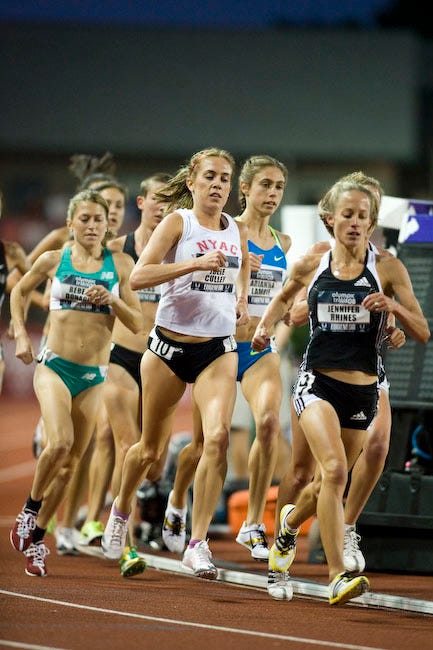
I enjoyed hearing Kara Goucher and Des Linden talk to fellow 2012 Olympian Julie Culley on the latest episode of Nobody Asked Us.
Paige Wood, who’s getting ready to run the New York City Marathon, discussed the ups and downs of her past several years of running on Road to the Trials.
Rachael Rudel talked about her USATF 20K win with her Front Range Elite co-founders on Conversation Pace with FRE, and I also enjoyed hearing more from her on C Tolle Run.
Additional Episodes: Shannon Rowbury on On the Record: The Elite Running Podcast—she and host Pete Julian did not discuss the more controversial sides to their past involvement with the Nike Oregon Project | Lindsey Butler on Trackside with Maddie Mooney—this was recorded a while back and Butler has since said she has a sponsorship announcement coming | Emily Schmitz discussed her third place finish at UTMB (at age 45) on Women of Distance | Elise Cranny on the Lactic Acid Podcast | Liberty University standout Allie Zealand on Pending Ratification
I’m writing this on a weekend when quite a few things in this part of the country, including some races, have been canceled due to a nor’easter. It’s just been a bit windy and quite rainy where I am, and I am grateful to have power. I hope all of you are staying safe and not stressing too much about how this may have affected your training.
I am so grateful to those of you who have supported this newsletter via Venmo or Patreon. I am still unable to thank people directly for their contributions in the Venmo app like I used to be able to, but please know that I am incredibly grateful for your support. And if you’d ever like to combine shopping at Running Warehouse and supporting Fast Women, you can use this link to start your shopping (And you can help yourself by using the code FASTWOMEN to save money on certain items.)
I hope all of you have the best week possible.
Alison
Bahrain at the Asian Games: "The country’s success is due in part to their recruiting efforts."
Heh ... "in part." 😏
The top three women's and men's finishers in the Berlin Marathon were all wearing the same super lightweight, super bouncy, Adidas prototype shoes. With Assefa on pace through 40k to lower Chepngetich's tainted record, after stringing together eight 5ks in the low 15s, she suffered an Achilles rupture. Unfortunately, one always wonders, after these amazing performances, about whether doping was involved, and about how much of a difference the new shoes make. I also wonder whether, after 25 miles of being trampolined by carbon fiber and super foam, the Achilles tendon said "no mas."